Table of Contents
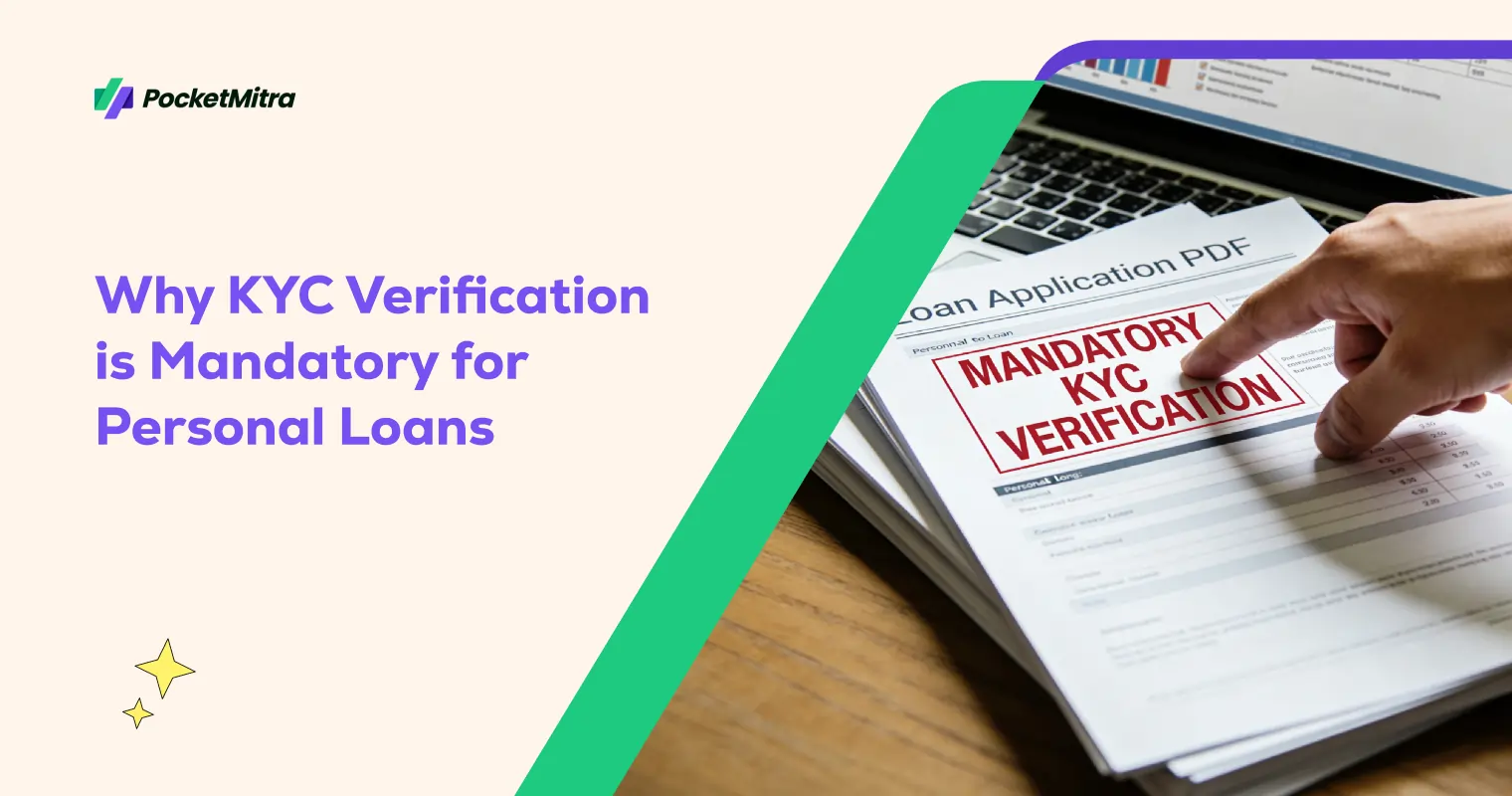
Why KYC Verification is Mandatory for Personal Loans
By PocketMitra | April 17, 2026
Introduction
Think about taking out a loan online at midnight owing to an emergency financial need and getting your application approved within minutes. Does that sound like an ideal scenario to you?
Now think of the above scenario without there being any identity verification process involved. Someone can simply submit false documents or use another person's bank account to apply for the loan. That's the exact reason why all lending companies are so particular about KYC.
Whether the borrower is applying through the physical location of the lending company or a mobile lending platform, the KYC process has become mandatory. Nowadays, no lending company approves its customer's application unless and until personal loans kyc verification is completed.
With the growing popularity of lending apps in India, KYC has taken on much more importance in the lending world. Besides helping lending firms to approve their customer's applications fast, KYC also ensures secure transactions in the process.
Let us understand the concept of KYC and find out why it matters when approving applications for personal loans.
What is KYC?
KYC means "Know Your Customer." KYC is a method employed by banks and NBFCs to authenticate a borrower before offering financial services.
Put simply, KYC is a process which allows lenders to ensure that the applicant is a real individual and that the details provided are genuine.
Some of the basic things required for personal loan verification are:
- Identity proof
- Address proof
- Mobile number
- PAN Card details
- Bank details
- Photo verification / selfie verification
With the advent of technology, digital lending platforms perform all personal loans verification online using Aadhar-based authentication and one-time password (OTP) verification techniques.
KYC isn't only for loans. The same KYC method is often employed when opening a bank account or making investments in mutual funds or insurance.
Types of KYC Verification Used for Personal Loans
The whole KYC process has undergone significant changes since online loan facilities have become more commonplace along with online verification mechanisms.
Present-day practices can vary from lender to lender depending on policies and regulations.
Physical KYC
Previously, customers had to go to the branch offices themselves and provide physical copies of documents for verification purposes.
eKYC
Under electronic KYC procedure, customers' identities are verified using Aadhaar-based authentication and OTP verification procedure, which has greatly facilitated the whole process of Aadhaar KYC loan applications.
Video KYC
Some companies have started offering video verification services in which customers show original documents while verifying their identity over a video session.
Digital Document Verification
Other popular methods involve PAN verification, bank details verification, selfie verification, and other types of document verification through digital platforms.
The Legal Mandate — Why Lenders Have No Choice
KYC is more than just a borrower's preference. There are legal obligations in place for the verification of the borrower's identity according to regulatory norms.
There are expectations placed on banks and NBFCs to conduct identity verification of the borrowers in order to avoid:
- Frauds
- Identity theft
- Fake loans
- Money laundering
Without proper identity verification, the bank could get into regulatory trouble or even fall prey to fraud.
That is why almost all KYC loan processes involve identity verification prior to disbursement.
As far as online lending platforms are concerned, the KYC process has become an essential part of loan processing.
Core Reasons KYC Is Mandatory for Personal Loans
Many applicants believe that the whole process of KYC has come into existence due to requirements by lenders. But in reality, there are various reasons why KYC is essential to the banking world.
Identity Verification
KYC enables lenders to authenticate whether the applicant is real and uses legitimate personal details.
Fraud Prevention
Verification systems help lenders reduce risks related to fake identities, duplicate applications, and financial fraud.
A verification process ensures that lenders are safe from any fraudulent activities such as identity theft and duplicate applications.
Responsible Lending
KYC allows lenders to evaluate applicants more accurately before approving loans.
Through the KYC process, lenders are able to assess their potential applicants better and make informed decisions.
Regulatory Compliance
It is mandatory for banks/NBFCs to maintain proper customer records according to the financial laws of the country.
In the present scenario, all lenders are largely dependent on personal loans kyc verification processes to ensure safer and more transparent lending practices.
How KYC Shapes Loan Terms — The Risk Connection
KYC does not only entail identifying one's self. It also assists the lender to determine their risks during the approval process.
If information provided is correct and full, then application processing will be easier for the lenders as they make the decision.
Some of the factors assessed during this stage are:
- Income status
- Employment situation
- Activities of the account holder in their bank
- Credit score
- Repayment of other loans
This explains why sometimes a hassle-free personal loan on kyc process could assist in getting approvals for borrowers that meet eligibility criteria.
Documents Required for KYC in Personal Loans
A few documents are generally requested by most financial institutions during the KYC procedure.
Some of the documents that are generally requested are as follows:
- Aadhaar Card
- PAN Card
- Passport size photo or Selfie
- Verification of mobile number
- Bank account details
- In some cases, address proof as well
The process of digital loan application involves submitting these documents using the app.
Several loan applicants go for aadhaar kyc loan due to their preference for digital documentation.
How KYC Helps in Faster Personal Loan Processing
Completing the KYC process successfully can help in minimising delays when applying and getting approved for the loan.
Some digital systems allow financial institutions to:
- Verify identity quickly
- Complete application faster
- Minimise the amount of paperwork involved
- Detect fraudulent activities more easily
- Easily onboard customers
Those searching for terms like "apply loan online instant approval" online usually favor such financial institutions due to the quick process that is involved in applying for the loan.
Automated verification systems are currently being used by most platforms to facilitate the personal loans verification process for qualifying applicants.
The KYC Process Step-by-Step
Even though there could be variations in the process across lending organisations, the general digital KYC procedure involves certain steps as outlined below.
| Step | Action | Details |
|---|---|---|
| 1 | Registration | An applicant submits personal data and registers himself/herself using a phone number. |
| 2 | Aadhaar & PAN Submission | The individual submits some basic documents to verify his/her identity. |
| 3 | OTP Authentication | Some lending organisations can authenticate the Aadhar-linked phone number using OTP verification. |
| 4 | Selfie or Video Verification | Lenders may ask for selfie verification or even live video KYC. |
| 5 | Verification Review | After submission of data or documents, the information goes under a digital check. |
All digital kyc loan applications nowadays are completed via smartphones without visiting any branches physically.
Eligibility Criteria You Need to Meet
Even after the successful KYC process, the applicants have to fulfill the general eligibility criteria for loan approval.
Lenders usually assess the following criteria:
- Age of the applicant
- Citizenship of India
- Source of income
- Open bank account
- Credit history
- Proper documentation
Successful personal loan on kyc process does not mean that the loan is automatically approved, but it makes the assessment easier for the lender.
What Happens If Your KYC Fails or Is Incomplete?
KYC failure does not necessarily lead to outright rejection but may cause a temporary halt to the application process.
The most common causes of KYC failure are:
- PAN details entered incorrectly
- Discrepancy in Aadhaar details
- Blurred document uploads
- Inaccurate mobile number
- Selfie verification failure
- Expired/Invalid documents
However, in most instances, these issues can be rectified and the documents re-uploaded for verification.
Digital KYC vs. Traditional KYC — What's Changed?
Traditional KYC procedures would take the borrower to visit branches in person, make photocopies of documents, sign in person, and wait longer.
Times have certainly seen major improvements because of technology.
Nowadays, users can verify their identity through:
- Aadhaar authentication
- One-Time Password Verification
- Selfie verification
- Video KYC
- Digital document verification
This has made the process much faster for borrowers using mobile lending applications.
With the increase in the adoption of digital lending, verification technologies will definitely make loan applications easier for qualified borrowers.
Conclusion
One of the most crucial processes associated with modern lending is known as Know Your Customer. It plays an essential role in identity verification, lowering risks of fraud, regulatory compliance, and streamlining application processes.
The advent of digital lending has been accompanied by changes in the field of identity verification. While before it involved paper-based approaches, now there are much faster methods that rely on digital identity verification.
Platforms like PocketMitra, which uses a digital verification approach that allows borrowers to make the borrowing process as easy and efficient as possible. When planning to borrow money, individuals are advised to make sure that all required personal information is valid to speed up the process.
FAQs
Is KYC mandatory for all personal loans in India?
Yes, KYC procedure is mandatory for personal loans in India. It is necessary for lenders to verify their customers' identity and address, as well as other financial information.
What are the different types of KYC accepted for personal loans?
Physical KYC, electronic KYC, video KYC, and KYC using Aadhaar numbers are some of the most common types of KYC used by lenders for personal loan applications based on their own process, regulatory requirements, and the kind of loan application being made.
Can I get a personal loan without an Aadhaar card?
A few lending institutions might consider other forms of ID proof, but for most digital loan disbursers, having a borrower's Aadhaar card helps streamline the entire KYC process.
How long does KYC verification take for a personal loan?
The process of digital KYC verification may take just a few minutes, whereas the process of physical KYC verification may take some extra time depending upon the documents' quality.
What are the most common reasons for KYC rejection in a loan application?
Some of the reasons that might lead to KYC rejection include wrong PAN details, poor quality of scanned images, non-matching Aadhaar numbers, failing in the selfie verification stage, and expired identity proofs.